

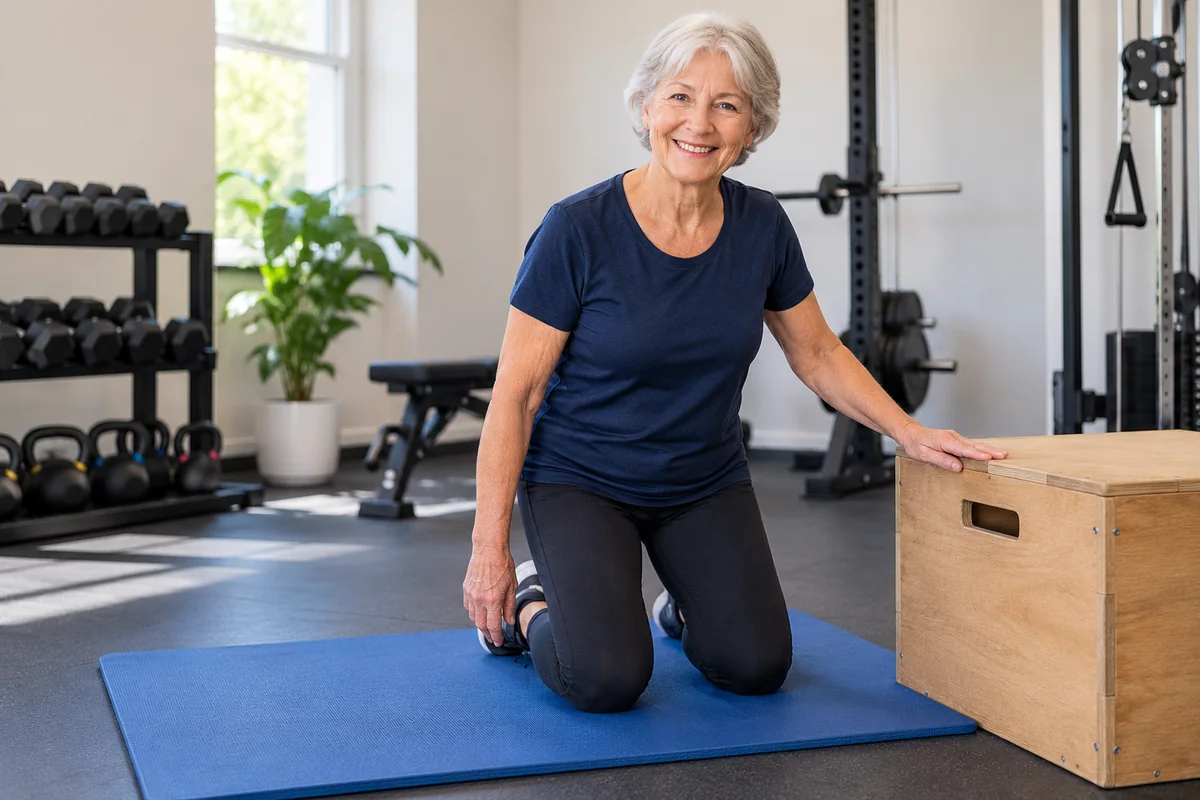
If you were sitting on the floor right now, could you get yourself back up again?
It's a question I recently asked members of our Over 60s Strength Classes at Chris Tiley Physiotherapy in Harborne.
For some, the answer was a confident yes. But several weren't so sure. Some hadn't tried getting down to the floor for years, while others were concerned about their knees, their balance or whether they'd be able to stand up again.
It's understandable. If getting onto the floor is something you rarely do, how would you know whether you can still manage it?
But here's the encouraging part: getting up from the floor is a skill that can be practised and improved, whatever your starting point.
Why does getting up from the floor matter?
When we talk about falls as we get older, most of the advice focuses on preventing them.
And rightly so. Improving strength, balance, and mobility can reduce the risk of falling.
But there's another question worth considering: what happens if you do end up on the floor?
Research involving people aged over 90 found that, among those who experienced a fall, 80% were unable to get themselves up after at least one fall. Around 30% spent an hour or longer on the floor.
These findings highlight why it's worth practising the ability to get up, rather than simply hoping we'll never need it.
Source: Fleming J, Brayne C. BMJ (2008), study of people aged over 90.
Of course, this isn't just about falls.
Think about some of the things you might want to do in everyday life:
- Get down to play with your grandchildren.
- Kneel while gardening.
- Retrieve something from underneath the furniture.
- Sit on the grass at a picnic.
- Get down to the floor to do some exercises.
Being able to do these things comfortably gives you more freedom and independence.
And perhaps just as importantly, knowing that you could get yourself up again can make the prospect of getting down to the floor feel much less daunting.
What happened when we tried this in our Over 60s Strength Classes?
I run small-group strength classes for older adults at our physiotherapy clinic in Harborne, Birmingham.
We regularly work on building strength, balance and confidence through exercises such as squats, step-ups and resistance training.
But after a conversation with fellow physiotherapist Dustin Jones on my podcast, The Never Too Old to Lift Podcast, I realised there was something we could be doing more of: practising getting down to the floor and back up again.
So I started introducing it into our classes.
Initially, several members were apprehensive.
Some were convinced their knees wouldn't cope. Others worried about losing their balance or becoming stuck on the floor.
Rather than asking everyone to perform the same movement, we broke it down into manageable stages.
Some people used a sturdy box for support and simply lowered their knees onto a padded step before standing back up.
Others were comfortable kneeling directly on a mat.
Some could lower themselves through a lunge, using their hands on their thighs for support.
And others progressed towards getting all the way down to sitting or lying on the floor before standing up again.
Everyone worked at a level that felt appropriate for them.
What I particularly enjoyed was seeing the reaction from people who had been convinced they couldn't do it.
Once they realised they didn't have to go straight from standing to sitting on the floor without using their hands, they became more willing to try.
And several surprised themselves with what they were capable of.
That's one of the things I enjoy most about working with people who are new to strength training. Sometimes the biggest achievement isn't lifting a heavier weight. It's discovering that something you thought was beyond you is actually possible.
How can you practise getting up from the floor?
The key is to start at an appropriate level and gradually build confidence.
Here are some of the stages we use.
1. Practise supported kneeling
Start with a sturdy, stable surface in front of you for support.
With appropriate padding beneath your knees, practise lowering one knee and then the other towards the floor, before returning to standing.
You might initially use a raised padded surface rather than going all the way to the floor.
2. Progress towards sitting on the floor
Once you're comfortable kneeling, the next challenge is lowering yourself into a sitting position.
You can use your hands for support and reverse the movement to return to kneeling, then standing.
3. Practise lying down and getting back up
If you're comfortable sitting on the floor, you can gradually practise lowering yourself onto your side or back, before reversing the movement.
This adds another level of challenge and helps you become familiar with moving between different positions.
4. Gradually reduce the support you need
As your strength and confidence improve, you might find you can complete some of these movements with less assistance.
Perhaps you initially needed both hands on a sturdy surface, but eventually only need one.
Or perhaps you can get down to the floor without assistance but still prefer to use your hands when standing up.
All of these are worthwhile improvements.
The goal isn't necessarily to get up without using your hands. It's to become more capable and confident than you were before.
Is it safe to practise at home?
For some people, practising these movements at home may be appropriate. However, it's important to consider your starting point and any existing health conditions.
Use a clear space, a comfortable padded surface and something genuinely sturdy for support.
If you have osteoporosis, a recent fracture, recent surgery, significant balance difficulties or concerns about whether the movements are appropriate for you, seek advice from your physiotherapist or another suitable healthcare professional before trying them.
And if you're particularly nervous about getting onto the floor, I'd recommend practising with professional supervision rather than attempting it alone.
There's no benefit in pushing yourself into a position you aren't confident you can get out of.
You don't need to wait until you're struggling
One of the things I often tell patients is that you don't have to be in pain to benefit from physiotherapy.
Perhaps you've noticed that getting out of a low chair has become more difficult.
Maybe you avoid kneeling because you're worried you won't be able to stand back up.
Or perhaps you simply want to maintain your strength and independence as you get older.
These are all perfectly good reasons to work on your physical abilities.
The earlier you start, the more opportunities you have to gradually build confidence.
Strength training for over 60s in Harborne, Birmingham
At Chris Tiley Physiotherapy, our Over 60s Strength Classes are designed to help people build strength, improve balance and feel more confident in everyday movements.
You don't need previous gym experience, and everyone works at a level appropriate to their abilities.
We use a combination of strength exercises, balance challenges and practical movements to help people become more capable over time.
If you're interested, you can find out more about our Over 60s Strength Classes.
We also offer a free Discovery Visit, where we can discuss the classes and whether they're suitable for you.
Want to learn more about getting up from the floor?
I've explored this subject in more detail in Episode 59 of my Never Too Old to Lift podcast.
In the episode, I explain why getting up from the floor matters, share more of my experience introducing these exercises into our classes and talk through a progression you can work towards.
You can choose whichever format suits you:
Listen to Episode 59: Never Too Old to Lift
Remember, getting up from the floor isn't something you either can or can't do.
It's a skill you can work on, one manageable step at a time.
And you might just surprise yourself with what you're capable of.
Chris Tiley is a Chartered Physiotherapist based in Harborne, Birmingham, with an interest in helping people build strength and confidence through exercise.