

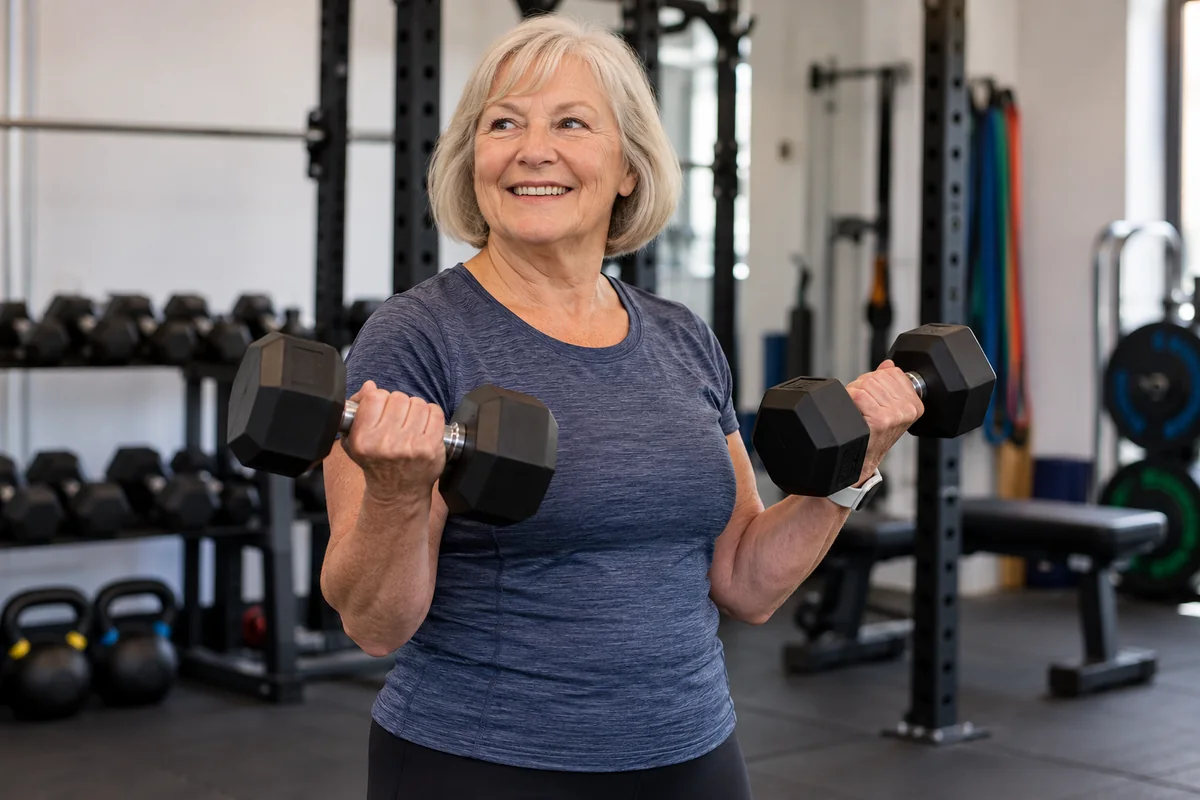
Getting older does not mean you have to accept becoming weaker.
Perhaps you want to keep playing golf or tennis, keep walking in the hills, look after your garden or keep up with your grandchildren. Or perhaps you simply want to stay independent, doing the things you enjoy without relying on somebody else. Strength training is one of the most useful things you can do to make that possible.
I’m Chris Tiley, a chartered physiotherapist and owner of Chris Tiley Physiotherapy in Harborne, Birmingham. Over the last 18 years I’ve worked in hospitals, sports teams and private practice. Along the way, I’ve developed a particular interest in helping older adults who lack the confidence to start strength training. That’s why I created Never Too Old to Lift, a podcast, YouTube channel and online community for people over 60 who want to get stronger.
In this article, I’ll explain why strength matters more as we get older, how to get started and how to progress safely. It’s the same approach I use with patients in clinic.
Why strength matters more after 60
As we get older, we gradually lose muscle mass and strength, a process called sarcopenia. By the time we reach 50, muscle mass is thought to decline at around 0.5 to 1% per year.
The numbers themselves are rarely the problem. What matters is what happens to everyday life. A common story I see in clinic starts with more demanding activities, such as golf or tennis, beginning to feel harder. People keep going for as long as they can, then eventually stop. Without that activity, strength declines faster. Before long, carrying the shopping, getting out of a low chair or doing the gardening becomes a challenge. Many people start relying on family, or paying someone else, for jobs they used to do themselves, and even a flight of stairs can become daunting.
The good news is that this cycle can be slowed and, in many cases, reversed. Starting strength training at any age can help you regain strength that has already been lost.
Strength also plays a part in several conditions I see regularly as a physiotherapist:
- Falls. Reduced muscle strength is associated with poorer balance and a higher risk of falls. The recovery period after a fall-related injury can then speed up further loss of strength.
- Osteoporosis. The Royal Osteoporosis Society recommends combining weight-bearing and impact exercise with muscle strengthening to keep bones strong. Strengthening should be done on two to three days a week, with the resistance increasing over time.
- Osteoarthritis. I often describe muscles as the suspension in your car. Stronger muscles absorb more of the impact, so less is transferred to your joints. That can help painful joints settle and let you get back to the activities you enjoy.
The World Health Organization recommends that all adults include muscle-strengthening activity on two or more days a week. Strength training is how you meet that recommendation in a way that also carries over into everyday life.
Start with your goal, not an exercise
Before you pick up a weight, it’s worth working out why you want to get stronger. Search online for exercises for over 60s and you’ll find hundreds of options, with no way of knowing which ones matter for you.
“Get fitter” or “feel stronger” are good reasons, but they’re too vague to measure. It helps to be more specific. What problem would strength training solve for you? What would you need to be able to do? What might get in the way, and how much time do you have?
A patient I saw in clinic was going on a scuba diving holiday four months after her first appointment. Following a recent episode of pain, she felt weaker than she had six months earlier and was worried she wouldn’t manage the physical demands of the trip. She had never done any strength training before.
Rather than giving her a list of exercises, we looked at what the holiday would ask of her. She would need to carry a 15kg dive tank while out of the water, wear another 10kg of lead weights, climb a ladder with that extra load and move around on an unstable boat. From there, we set specific goals: lifting 25kg from the floor, walking 10 metres carrying 25kg, standing up from a chair with a 25kg barbell across her shoulders, and stepping up onto a 30cm step while holding 25kg.
Those goals shaped every exercise we chose. She could see exactly how each squat or step-up was helping her get back in the water. She went on the holiday and loved it, and has since been on skiing holidays too, something she had resigned herself to giving up.
Your goals will look different, but the process is the same. When you understand why you’re doing an exercise, you’re far more likely to keep going.
The 7 functional movement patterns
If you look at the things you do every day, you’ll see the same movement patterns again and again. I group them into seven functional movements:
- Squat: sitting down to a chair and standing back up
- Hip hinge: bending forwards from the hips to pick something up
- Lunge: stepping, and climbing stairs
- Push: pushing a load away from you, or pushing yourself up from the floor
- Pull: pulling a load towards you
- Rotation: turning your body, or resisting being pulled into a twist
- Gait/carry: walking, and carrying things as you go
Getting stronger in these patterns makes the same movements easier in everyday life. They also give you a simple way to check that your programme covers everything you need. I explain each one in more detail, with ways to make them easier or harder, in The 7 Functional Movements.
Find the right starting point
If you look at an exercise and think “I can’t do that”, it doesn’t mean the movement isn’t for you. In my experience, the movement you struggle with is often the one you most need to practise. You just need a version that suits you today.
Almost every exercise can be adapted:
- Squat: if a full squat is too much, squat to a chair or bench, lightly tapping it before standing back up.
- Split squat: if lowering your back knee to the floor is difficult, a cushion or small step underneath it reduces the depth.
- Push: if lifting your arms overhead is uncomfortable, a chest press lying on your back may suit you better than a shoulder press.
As that version becomes easier, you progress it. You might add weight, increase the range of movement or move on to a harder variation.
How often, and how many reps?
For most people starting out, two sessions a week is a good minimum and three is plenty. Leave at least a day between sessions so your muscles have time to recover. Around 30 minutes is enough to cover the key movements.
The thing that makes strength training work is intensity. Each set should be challenging enough that, by your final repetition, you couldn’t manage another with good form. Most people are too cautious and never challenge themselves enough, which is why they don’t see progress.
Going straight to heavy weights isn’t the answer either. The approach I use starts at 15 repetitions. You then gradually increase the weight, so the target number of repetitions comes down over 12 weeks:
Not everyone will reach 5 repetitions in 12 weeks, and that’s fine. If you need an extra week or two at any stage, take it. Your programme should progress with you, not the other way round.
If reps, sets and “reps in reserve” are new to you, I explain them fully in What Do Reps and Sets Mean? 6, 12 & 15 Reps Explained.
It’s also normal to feel some muscle soreness a day or two after your first few sessions. This usually eases as your body adapts, and starting at higher repetitions helps keep it manageable.
What equipment do you need?
Less than you might think. You can train in a gym, where there’s more equipment and staff on hand to help, or at home.
For home training, a pair of adjustable dumbbells and some resistance bands will cover all seven movements. Dumbbells are also a sensible choice when you’re training on your own. If you lose your balance or tire sooner than expected, you can simply let them go.
Keep it simple at first. Too much choice can make getting started harder, and you can always add equipment as you progress.
What if you have pain or an existing condition?
This is where my work as a physiotherapist comes in most. A painful knee, a stiff back or a previous injury doesn’t automatically rule out strength training. More often, it means adapting where you start. You might reduce the load, change the range of movement or your position, or choose a different variation of the same movement pattern.
A simple rule I give patients:
- Mild discomfort, but you can keep good control: reduce the load for the rest of that session, and possibly the next.
- Pain that makes you grimace, or stops you moving with control: stop that exercise for the day.
- Pain that persists: see a physiotherapist or other medical professional.
If you’re injured, unwell or have a medical condition that may affect your ability to exercise, seek appropriate advice before you start.
Based in Birmingham? If you’re over 60 and would rather have support than work this out on your own, our Over 60s Strength Classes at Chris Tiley Physiotherapy in Harborne are designed to help you build strength and confidence in a supportive environment. Find out about our Over 60s Strength Classes
A simple way to get started
- Decide why you want to get stronger. Think about what you want to keep doing or get back to.
- Turn it into a specific goal. “Get up from a chair without using my hands” is easier to work towards than “get fitter”.
- Identify the movements involved. Which of the seven functional movements does your goal rely on?
- Choose a starting version of each exercise. Pick one you can do with confidence and control.
- Plan two or three sessions a week, with a rest day in between.
- Write down what you do: the date, the number of reps and the weight you used.
- Increase the challenge gradually as each exercise becomes easier.
- Keep your goal in sight. If you’re working towards golf, the squat isn’t just a squat. It’s getting you back on the course.
Strength training is about your future
Imagine yourself at 80. What would you like to still be doing? Where would you like to go, and who would you like to spend time with?
Strength training is one of the most practical ways to work towards that future. You don’t need to become exceptionally strong or spend hours in a gym. You need to start where you are, challenge your muscles appropriately and progress from there.
You’re never too old to start getting stronger.
Where to go next
If you’re in or near Birmingham
If you’re over 60 and based in or near Birmingham, you can get support in person through our Over 60s Strength Classes at Chris Tiley Physiotherapy in Harborne. These sessions are designed to help you build strength progressively and feel more confident with exercise.
If you’re dealing with pain, recovering from an injury, or feel you need more individual support first, our Strength & Rehab Classes may be a better starting point.
Wherever you are
My free Never Too Old to Lift guide takes you through the full process step by step: setting your goals, choosing your exercises, planning your first workout and progressing over 12 weeks.

About the author
Chris Tiley
Chris Tiley is a chartered physiotherapist and owner of Chris Tiley Physiotherapy in Harborne, Birmingham. He qualified from Coventry University in 2008 and has worked in hospitals, sports teams and private practice, including with GB Para Snowsport. He specialises in strength training for older adults, is a regular speaker at Therapy Expo, and is the founder of Never Too Old to Lift.